
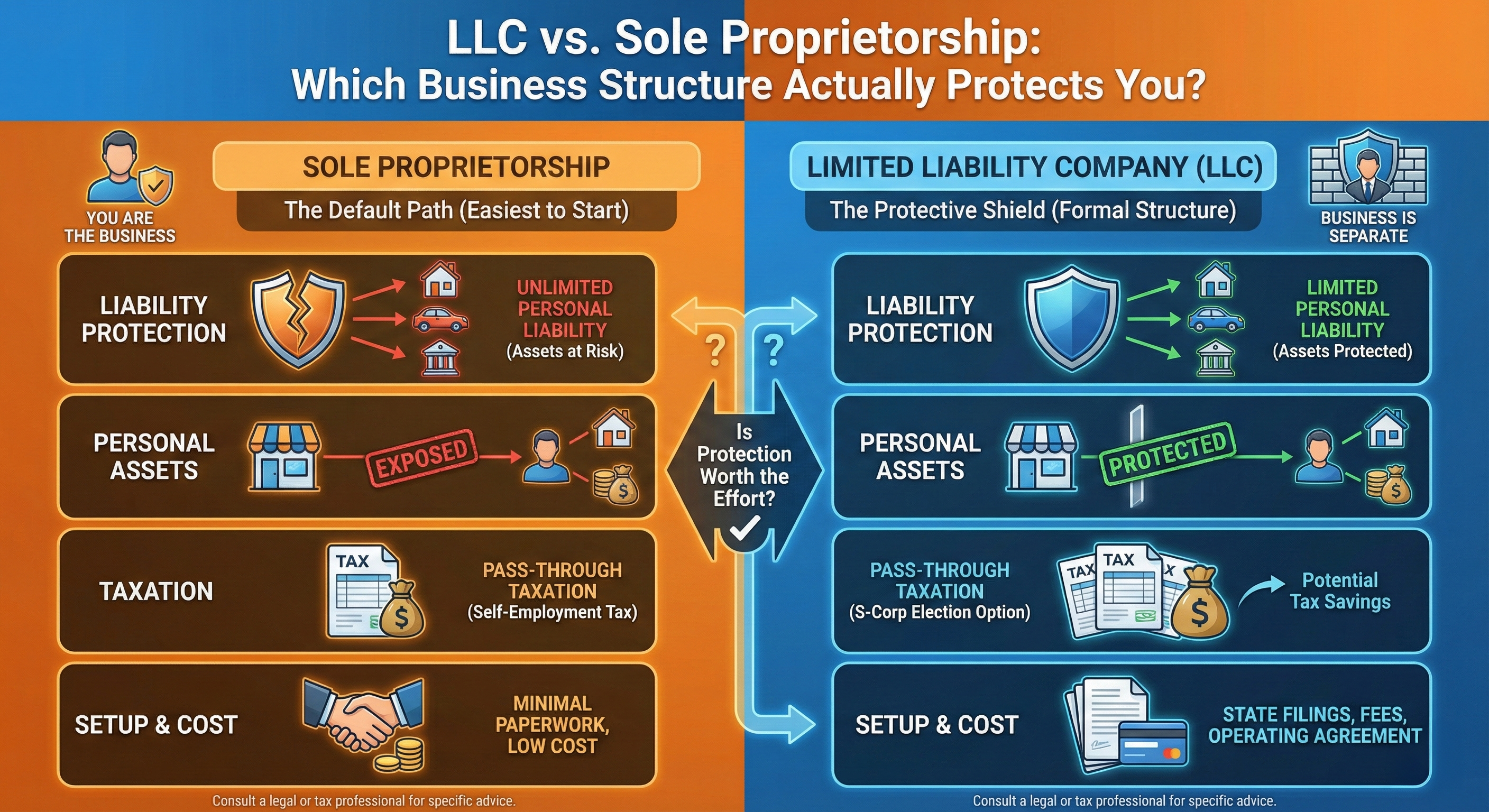
If you’re trying to decide between an LLC and a sole proprietorship, you’re basically asking one big question: “If something goes wrong… do they come after my business… or my house?”
Historically, small businesses didn’t have a lot of options. You either just “were” the business (a sole proprietorship), or you went full corporate, which was expensive and paperwork-heavy. A sole proprietorship is the default: if you’re an individual running an unincorporated business and you don’t set up anything special, the IRS treats you as a sole proprietor by default.
Legally, that default comes with a huge catch: the business has no separate legal identity. You and the business are one and the same, so business debts and legal claims are your debts and legal claims.
LLCs came along as a middle ground: easier than a full corporation, but with a key upgrade, limited liability. An LLC is a separate legal entity under state law, and in most cases, members’ personal assets aren’t on the hook for business debts or lawsuits against the company. That’s the “liability shield” everybody talks about.
Over the last couple of decades, LLCs have become the go-to for small businesses in the U.S., freelancers, online shops, real estate investors, consultants, because they blend pass-through taxation with that liability protection. At the same time, sole props are still incredibly common, especially for side hustles, tiny one-person operations, and folks just testing an idea.
Layered on top of that, we’ve had recent regulatory drama around the Corporate Transparency Act (CTA), which was supposed to make many companies (including LLCs) report their beneficial owners to the Treasury’s Financial Crimes Enforcement Network (FinCEN). After legal challenges and a 2025 rule change, domestic companies are now exempt from that federal ownership reporting requirement; enforcement is focused on certain foreign entities instead. That matters because it changes how much extra admin headache comes with forming an LLC.
So the real puzzle today is: if the paperwork gap between “do nothing” (sole prop) and “set up an entity” (LLC) has shrunk, is it finally time to stop running your life through your personal checking account and get some real protection?
So… what are we actually deciding between here?
At a high level, here’s the choice:
Sole proprietorship (the “default”):
- No formal formation required, if you’re the only owner and just start doing business, you’re a sole prop in the eyes of the IRS unless you’ve created something else.
- Easy taxes: you report business income and expenses on Schedule C of your personal tax return.
- But: zero legal separation between you and the business, unlimited personal liability for business debts and obligations.
Limited Liability Company (LLC) (the “shield”):
- Formed at the state level by filing articles of organization and paying a fee; often requires a registered agent and some annual filings.
- Can usually choose how you’re taxed: disregarded entity (like a sole prop), partnership, S corp, or C corp, depending on your situation.
- Key feature: limited liability. In most cases, your personal assets are protected from business creditors and lawsuits against the LLC, as long as you don’t personally guarantee debts or commit fraud.
So when you ask, “Which structure actually protects me?” you’re really asking: “Do I want the legal firewall of an LLC badly enough to justify the extra setup and maintenance?” And the honest answer is: if you have real risk, real money, or real assets to lose… the LLC usually earns its keep.
Bottom line: which structure actually protects you?
If you just want a straight answer, here it is in list form so your future self can screenshot it and send it to your accountant:
-
- For personal asset protection, an LLC almost always protects you better than a sole proprietorship, as long as you run it properly and don’t personally guarantee everything in sight.
More specifically:
- Sole proprietorships offer basically no legal shield. The IRS, state tax agencies, and small-business resources agree that a sole prop has no separate legal identity; business debts and liabilities are your personal obligations. If you’re sued or can’t pay business debts, creditors can go after your car, home equity (subject to homestead rules), savings, and other personal assets.
- LLCs generally protect your personal assets from business obligations. SBA and major legal/tax guides consistently highlight that an LLC creates a separate legal entity, and members typically aren’t personally responsible for business debts or lawsuits against the LLC, absent personal guarantees or misconduct.
- That protection isn’t magic, it’s conditional. Courts can “pierce the veil” if you commingle funds, undercapitalize the business, commit fraud, or treat the LLC like a toy instead of a real company. Professional malpractice (doctors, lawyers, etc.) and your own personal negligence can still reach you personally, entity or not.
- Regulatory overhead on LLCs has recently gotten lighter on the federal side. The Corporate Transparency Act originally required many small LLCs and corporations to report their beneficial owners to FinCEN, but a 2025 interim rule now exempts domestic companies, while foreign reporting companies still have to file. That means forming an LLC is currently less of a federal compliance headache than it was shaping up to be.
- Insurance + clean operations matter as much as your entity choice. An LLC helps keep a bad business event from becoming a personal financial disaster, but liability insurance, proper contracts, and actually respecting the LLC’s separateness are what make that shield hold up when things get ugly.
So, if your question is, “Which structure actually protects me?” the short, boring-but-true answer is: an LLC gives you real, legally recognized protection that a sole proprietorship just does not provide, assuming you treat it like a real business and pair it with decent insurance.
How the legal protection actually works (and when it doesn’t)
Let’s zoom in on what “protection” actually means, because this is where people either become overconfident (“I have an LLC, I’m invincible”) or overly scared (“If they can ever pierce the veil, what’s the point?”).
1. Liability shield mechanics
When you form an LLC, state law treats that company as a separate legal person. That “person” owns the business assets, signs contracts, and owes the debts. If the LLC is sued, the default rule is that only the LLC’s assets are on the line, not your personal bank accounts, home, or car.
Compare that to a sole prop: you are the business. Sue the business = sue you. There’s no intermediate bucket of “business-only assets” that creditors are restricted to.
2. When the LLC shield does not save you
There are several classic ways people accidentally (or intentionally) step outside the shield:
- Personal guarantees. Lenders, landlords, and sometimes vendors will ask you to personally guarantee obligations. If you sign that, you are personally liable, LLC or not.
- Mixing money. Using your business account like a personal piggy bank, paying your rent from the LLC without treating it as an owner draw, or never keeping basic records, these are the kinds of things courts look at when deciding whether to ignore the entity and come after you personally.
- Fraud or intentional misconduct. If you lie, commit fraud, or do something intentionally harmful, no entity is going to shield you from your own bad acts.
- Professional negligence. If you’re a licensed professional (doctor, lawyer, CPA, etc.), your entity might shield your personal assets from business-level debts, but your own malpractice is typically still on you personally. That’s why professional liability insurance is huge in those fields.
3. Litigation risk vs. everyday risk
Think about your actual risk profile:
- Low-risk side hustle: You’re doing simple digital services, very low dollar amounts, and minimal physical or legal risk. Here, a sole prop plus good contracts and maybe basic insurance might be okay, especially while you’re just testing.
- Medium to high risk: You’re dealing with customers in person, selling physical products, doing anything with safety implications, or signing leases and bigger contracts. In this world, the downside of being personally on the hook is much higher, and an LLC starts to look less like “nice-to-have” and more like “why haven’t you done this yet?”
4. Taxes & protection are separate conversations
A weirdly common misconception: some people think the LLC’s tax treatment is the protection. It’s not. You can have a single-member LLC taxed as a sole proprietorship and still have legal separation between you and the business; the IRS just ignores the entity for tax purposes, but state law still recognizes it.
So when you’re deciding between “LLC vs. sole prop,” don’t get distracted by the tax alphabet soup. Ask first: “Do I want legal separation?” Then decide how you want that entity taxed.
Pros and cons: LLC vs. sole prop in real life
Here’s a practical comparison, not theory, just how this feels when you’re actually running a business.
Sole proprietorship – advantages
- Cheapest and fastest to start. Often no state-level filing to exist as a sole prop; you might just need local licenses, permits, and maybe a DBA name.
- Simple tax filing. One Schedule C on your personal return, no separate entity return.
- Full control. There’s one boss: you. No operating agreement, no partners (unless you choose to bring them in and form something else).
Sole proprietorship – disadvantages
- Unlimited personal liability. If the business is sued or can’t pay its debts, your personal assets are exposed.
- Less credibility. Some clients, banks, and partners view “YourName, LLC” as more serious than just your personal name.
- Harder to separate money and build business credit. You can absolutely open a business bank account as a sole prop, but the lines tend to get blurrier, and some lenders prefer entities.
LLC – advantages
- Limited liability protection. Your personal assets are generally shielded from business debts and lawsuits, as long as you respect the entity and don’t personally guarantee.
- Brand and credibility boost. An LLC name can look more “legit” to banks, vendors, and customers.
- Flexible tax options. You can keep default pass-through taxation or, once it makes financial sense, elect S corp status and potentially save on self-employment taxes (with help from a tax pro).
- Easier ownership changes. Bringing in partners, investors, or selling portions of the business is usually cleaner via membership interests than trying to untangle a sole prop.
LLC – disadvantages
- Formation and maintenance costs. State formation fees, maybe annual franchise taxes or reports (looking at you, California and others), and possible registered agent fees.
- More admin overhead. You should have an operating agreement, separate bank accounts, and some basic records of major decisions.
- Still not a force field. Personal guarantees, fraud, and your own negligence can absolutely still reach you.
If you think of your life like a balance sheet, a sole prop is like running your business directly on your personal balance sheet. An LLC lets you create a separate page in the notebook for “Business Stuff,” so that a disaster on that page doesn’t automatically spill all over the rest of your financial life.
Banking, credit, and insurance moves that make your entity choice actually work
This is where the personal finance and banking side really kicks in. Your choice of entity is only half the protection story; how you run the money is the other half.
1. Separate banking is non-negotiable
Whether you’re a sole prop or an LLC, open a dedicated business checking account. For an LLC, it’s absolutely critical for maintaining the liability shield, courts look at whether you treat the business as separate. For a sole prop, it still helps you: cleaner bookkeeping, easier taxes, and a stronger case for business deductions if you’re ever audited.
Many banks and fintechs will run KYB (Know Your Business) checks differently for LLCs vs sole props, LLCs often need entity documents, while sole props are typically verified under the owner’s identity. Expect to provide an EIN for the LLC and, often, just your SSN and DBA for a sole prop.
2. Get an EIN even if you don’t “need” one
Sole proprietors can often operate using their Social Security number, but getting an Employer Identification Number (EIN) from the IRS is free and lets you keep your SSN off W-9s, invoices, and vendor forms. It also tends to make banking and payment processors happier.
For an LLC, you’ll almost always want (or need) an EIN for taxes, payroll, and banking.
3. Use insurance to backstop the entity
Think of your entity as the walls of the house and your insurance as the roof. You want both.
- General liability insurance for slip-and-fall type stuff and third-party property damage.
- Professional liability / errors & omissions if you give advice or services (consultants, designers, coaches, etc.).
- Product liability if you sell physical goods.
- Business umbrella policy for extra coverage on top of primary policies.
Insurers and brokers often view LLCs as more “formal” and may offer slightly different options or pricing versus a pure sole prop, especially as the business grows and adds employees.
4. Don’t neglect business credit & financing
Over time, you want your business to stand on its own financially:
- Open business credit cards under the business (often still with a personal guarantee at first, but it starts building a business profile).
- Use consistent business banking so lenders can see clean revenue history.
- Gradually move toward facilities that rely more on business financials and less on your personal credit.
An LLC structure makes this path cleaner, because the entity is clearly separate and can accumulate its own credit history more naturally than a sole prop, which is always “you” for legal purposes.
Big caveat: None of this is legal or tax advice. Think of this as a friendly, financially nerdy overview to help you ask better questions when you talk to your own CPA or attorney.
Quick recap + where to learn more
- Sole proprietorship is the automatic, simplest option, but offers no legal separation and unlimited personal liability for business debts and lawsuits.
- LLC requires setup and some ongoing maintenance, but gives you a real liability shield between your personal assets and your business, assuming you respect the entity and don’t personally guarantee everything.
- Recent rules around beneficial ownership reporting have eased up for domestic companies, reducing one of the newer administrative burdens that was looming over small LLCs, with FinCEN now focusing on certain foreign entities instead.
- Protection is a system, not a checkbox. Entity choice + separate banking + good insurance + sensible contracts = a much more resilient setup than just “I filed an LLC once.”
If you want to go deeper or fact-check anything (which you absolutely should), these are solid starting points:
- U.S. Small Business Administration on choosing a business structure: SBA: Choose a business structure
- IRS overview of business structures and sole proprietorships: IRS: Business structures and IRS: Sole proprietorships
- U.S. Chamber resources comparing LLCs and sole proprietorships: Sole Proprietorship vs. LLC and Guide to Sole Proprietorships
- FinCEN / Treasury updates on beneficial ownership reporting and the Corporate Transparency Act: FinCEN BOI page and recent coverage like Reuters: US firms BOI reporting exemption
Leave a Reply